A City of Church Music
From Scheidt to the bells of the Red Tower, four centuries of unbroken praise
“I know that my Redeemer liveth”— Aria from Handel's Messiah; today the hourly chime of the Red Tower's carillon
In Halle, faith can be heard. Scheidt played the organ in the salters' own church, Handel was baptized in the Marktkirche, Bach came here to test an organ, and his eldest son served as organist here for eighteen years; today, the Red Tower at the city's center chimes the hour with a melody from Messiah. For four hundred years, this city has kept singing out what it believes.
The Forerunner
When people speak of church music in Halle, they think first of Handel; but a full century before him, this city already had a master of its own. Samuel Scheidt (1587–1654) was born in Halle and died in Halle, and served as organist at St. Moritz, the mother church of the town's salters. As a young man he traveled to Amsterdam to study under Sweelinck; on his return he wrote the Tabulatura nova (1624), a landmark in the history of organ music, and later generations would count him among the early German Baroque's “three S's.” The sound of the organ in Halle has never stopped since.
The Organist at Seventeen
On 23 February 1685, Handel was born in Halle, and the very next day he was baptized at the Marktkirche. He trained under the church's organist, Zachow; on 13 March 1702, at seventeen, he was appointed organist of Halle Cathedral — a church of the Reformed (Calvinist) congregation. That a Lutheran boy should play the organ in a Calvinist church is itself a footnote to Halle's breadth of spirit. The following year he left for Hamburg; and later, the “Hallelujah” of Messiah would carry this city's name around the world.
Bach, Father and Son
In December 1713, the Marktkirche elected a new organist: J. S. Bach of Weimar. The Weimar court raised his salary to keep him, and in February of the following year he withdrew his acceptance. But the connection was not broken — in 1716, Bach traveled to Halle together with Kuhnau and others to test and approve the church's newly built organ. Thirty years later, his eldest son W. F. Bach took up the post of music director and organist there in April 1746, and held it until June 1764 — eighteen years in all — earning him the name “the Halle Bach.”
Two Organs
Walk into the Marktkirche today and you will find two organs. The small one on the east side is the 1664 Reichel organ — the very instrument the young Handel learned on, and the original still survives. The large one on the west side needs to be told in two parts: its case dates from 1716, the same Cuntzius organ Bach came to test that year, while its inner mechanism was rebuilt by Schuke in 1984, with about 4,170 pipes. One organ heard Handel's boyhood practicing; the other sounds a new voice inside a three-hundred-year-old case — old and new, ringing out together under the same roof.
The Congregation's Song
Beyond the organs and the organists, there was the song of the congregation. In 1704, Freylinghausen compiled his hymnal in Halle: 683 hymns and 173 tunes, the single most important hymnal of Pietism. His ties to the Halle orphanage ran deep — in 1715 he married the only daughter of August Hermann Francke (1663–1727), and from 1727 he co-led the Foundations together with Francke's son. The orphanage's faith and the congregation's song sprang, in the end, from the very same source.
The Bells Today
This musical thread remains unbroken to this day. Halle held its first Handel Festival in 1922, and the festival has run annually since 1952, with Messiah a frequent centerpiece; the old church of St. Ulrich, converted into a concert hall in 1976, now serves as the festival's main venue — a church becoming a concert hall is a very Halle kind of turn.
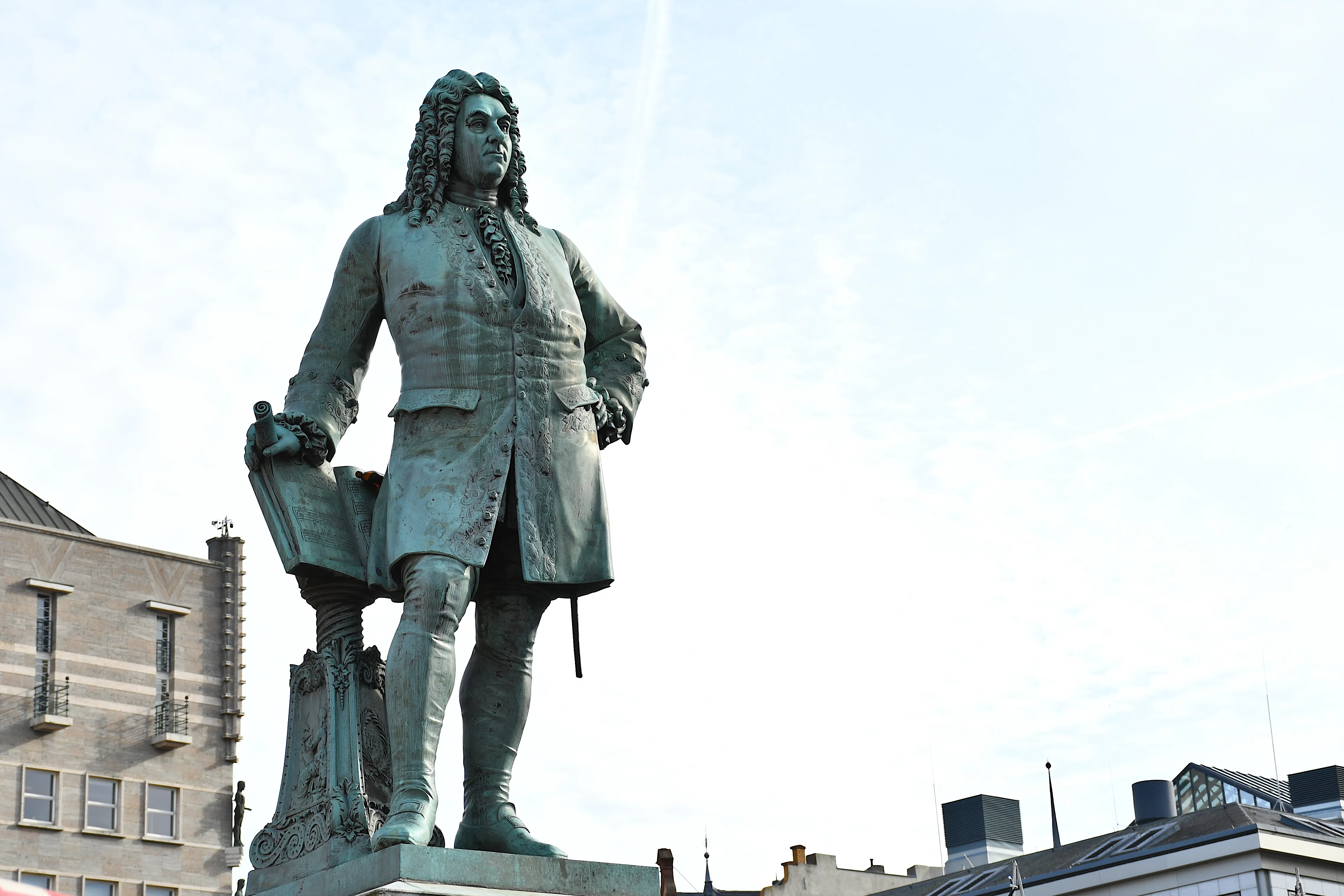
And at the city center, 76 bronze bells hang in the Red Tower, completed in 1999 and said to be the largest carillon in Europe; the hourly chime is drawn from the Messiah aria “I know that my Redeemer liveth.” Every day, the heart of Halle proclaims the resurrection in the sound of bells. Handel's bronze statue stands in the Marktplatz, between the twin towers of the Marktkirche; and when we sing in this city in Chinese, it is that very same risen Lord we worship.
People in this line
Sources