The Reformation: The Other End of the Storm
The indulgence machine stood in Halle; twenty-four years later, so did a Good Friday sermon.
Everyone remembers Wittenberg in 1517, but few ask where the powder keg that ignited the Ninety-Five Theses actually stood. The answer is Halle. The indulgence machine was set up in this city, and the relic collection's ledger recorded more than 39 million years of remission. The other end of the storm is the very city we now call home.
City of Cloisters
Before the Reformation, Halle was first a city of monastic orders. In 1116, the Archbishop of Magdeburg founded Kloster Neuwerk; the Augustinian canons ran schools there, making it the medieval city's spiritual center. The salt workers kept their own Moritzkirche. In 1271, the Dominicans began building what would become the cathedral. Piety built in stone waited quietly for a storm.
The Cardinal's Ledger
Around 1514, Cardinal Albrecht von Brandenburg (1490–1545) took up residence at Moritzburg in Halle. To hold the archbishopric of Mainz as well, he borrowed tens of thousands of guilders from the Fugger banking house. A 1515 papal bull split the proceeds of the indulgence trade in two — half to rebuild St. Peter's Basilica in Rome, half to repay his debt. In January 1517, Johann Tetzel was appointed general agent for the indulgences; that October, the indulgence instructions reached Martin Luther's hands and directly triggered the Ninety-Five Theses.
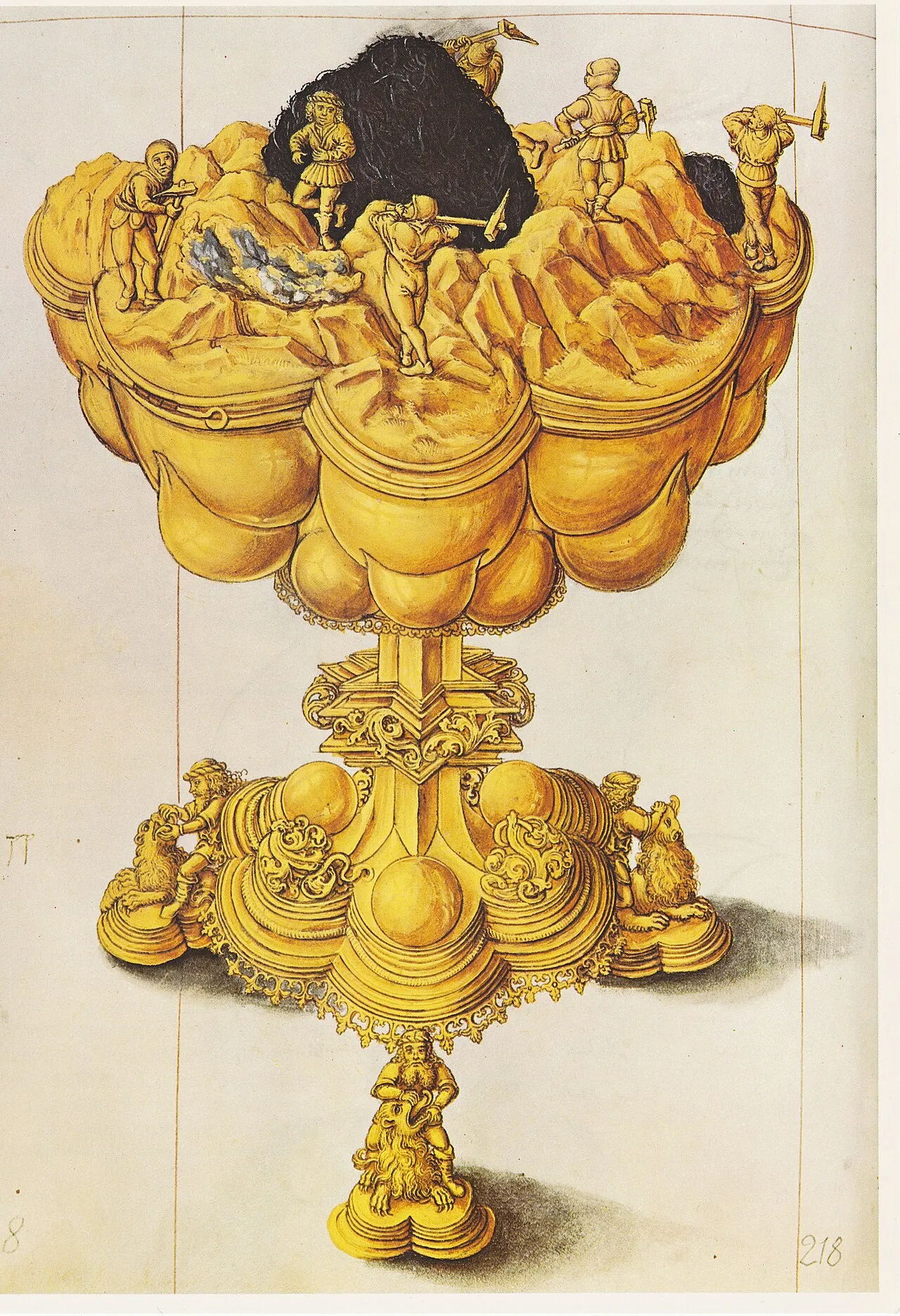
The cardinal's true capital lay deep within his cathedral: the Halle relic collection (Hallesches Heiltum). According to the illustrated relic catalogue printed in 1520, it held 42 complete bodies of saints, 8,133 relic fragments, and 353 precious reliquaries — with the years of indulgence recorded down to the day: 39,245,120 years and 220 days. The Elector of Wittenberg's relic collection, by comparison, offered only about 1.9 million years at the time — Halle's was twenty times the size. The relic arms race between the two cities was the backdrop to the storm of 1517.
The Wartburg Tract
In October 1521, Luther, hiding at the Wartburg, wrote the tract Against the Idol at Halle. Georg Spalatin, acting on the Elector of Saxony's orders, suppressed the manuscript. Luther then wrote directly to Albrecht on 1 December, giving him fourteen days to end “the idolatry at Halle” or see the tract published. On 21 December, the cardinal backed down and replied with an abject letter of concession. The tract was never published in Luther's lifetime; the manuscript survives today in Oxford. Halle's relics had little time left.
Good Friday
On 21 February 1541, Albrecht, after twenty-seven years in Halle, was driven out. Forced to dissolve the collegiate foundation he had established there, he withdrew to Aschaffenburg with the relic collection and his Cranach paintings, leaving the city for good. On 15 April that year, Good Friday, Justus Jonas, arriving from Wittenberg, preached Halle's first Protestant sermon at the Marktkirche; on 28 April he administered communion in both kinds. The Halle Church Order was issued in 1543, and on 3 November 1544 the city council formally ordained Jonas. The Reformation in Halle began with a Good Friday sermon.
Held by the Saale
Luther stood in the Marktkirche pulpit three times in his life: once on 5 August 1545, and twice in January 1546. The last time was unplanned. That January, on his way to Eisleben to mediate a dispute, he found the Saale swollen with thawing ice and impassable. Stranded in Halle, he stayed with his close friend Justus Jonas and simply preached where he was. What kept him in the Halle pulpit was the same river that still runs through this city.
Luther died in Eisleben on 18 February 1546. His coffin, on its way to burial in Wittenberg, passed through Halle: it arrived on the evening of 20 February and lay overnight in the Marktkirche's old sacristy before the burial in Wittenberg two days later. A Halle painter is said to have taken wax casts of his face and hands at his deathbed — they remain in this church to this day.
The Church's Reversal
The Marktkirche itself is the storm's most silent witness. In May 1529, the city decided to merge two old churches — St. Gertrude's, the salt workers' guild church, and St. Mary's, the merchants' guild church — keeping both pairs of towers and joining them with a new nave. Albrecht himself set the project in motion, intending it to hold back the Reformation. Halfway through construction, Halle changed sides in 1541, and by the time the building was finished in 1554, it was already a Protestant church. Raised to block this word, it stood finished to proclaim it. Today, a community of Chinese Christians worships the same God in this city, in Chinese — we, too, stand at the other end of the storm.
People in this line
Sources