The Origin of Missions
A call no one answered, and its echo across almost two centuries
The first light of the modern missionary movement was fired from Halle. In 1705, the Danish king's call for missionaries went unanswered at home, and it eventually landed on Halle; on 9 July the following year, two young men stepped onto the shores of India. The first organized Protestant overseas mission in history — its people and its theology alike — came out of this city.
No One Answered
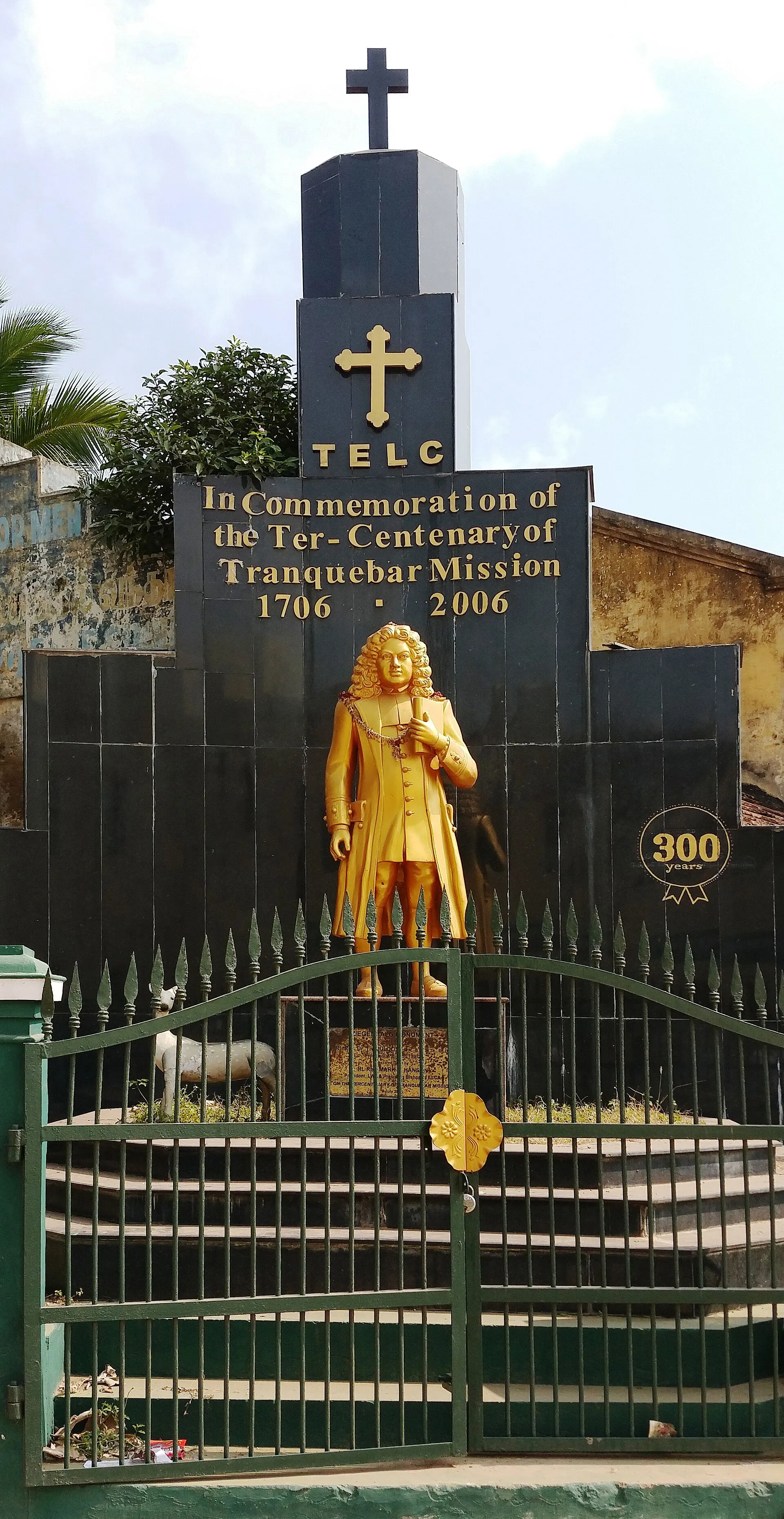
In 1705, King Frederik IV of Denmark resolved to send missionaries to India. The call went out, but no one at home answered it. The two men finally chosen came through August Hermann Francke's (1663–1727) circle — Ziegenbalg and Plütschau — so that both the people and the theology came from Halle. They set sail on 29 November 1705 and stepped ashore at Tranquebar in India on 9 July 1706.
This was the first organized Protestant overseas mission in history, purpose-built for the task. Before it, there had only been military chaplains and scattered forerunners; a structured process of selection, sending, and continuation began here for the first time.
Translation and Type
Five years after landing, in 1711, Ziegenbalg finished translating the New Testament into Tamil. In 1712/13 the mission built India's first Protestant printing press, making Tamil the first Indian language ever set in movable type; the Gospels came off the press in 1714, and in 1715 the complete New Testament was published — the first complete printed New Testament in an Indian language. In 1733, Aaron, India's first native Lutheran pastor, was ordained: the gospel had begun to speak the local language, and to be preached by local people too.
Missions on Paper
None of this stayed far away. From 1710 on, Francke had the Halle Reports printed at the orphanage in Halle — history's first Protestant missionary periodical. Mission news now went to press on a regular schedule, and for the first time European readers could follow the reality of overseas mission work at regular intervals.
Those Who Followed
People kept coming, generation after generation. In the eighteenth century, at least 60 students from the University of Halle went out to overseas missions; the most famous of them, Christian Friedrich Schwartz, arrived in India in 1750 and served there for 48 years until his death (1750–1798), making him the most celebrated missionary in eighteenth-century India.
Movement and Scholarship
In 1793, William Carey arrived in India; the modern missionary movement is usually dated from him. Yet the precedent he cited in his Enquiry was the Danish-Halle Mission itself. Carey and his companions established themselves at Serampore under the protection of a Danish governor — a man deeply influenced by Schwartz. Halle was the first wave; Carey was the second, standing on its shoulders.
About a hundred years later, in 1896, Gustav Warneck (1834–1910) was appointed professor of missiology at the University of Halle — the world's first Protestant chair of missiology — earning him the title “father of Protestant missiology.” Mission work had set out from Halle; a hundred and ninety years later, it became an academic discipline in Halle too.
The Door Still Open
What does the origin of missions have to do with a Chinese fellowship in this city today? Halle never sent missionaries directly to China. But one thread does lead, in truth, to us. George Müller (1805–1898), a theology student who was born again in Halle, was deeply moved after reading Francke's biography and went on to found orphanages in Bristol run on prayer alone; Hudson Taylor, who founded the China Inland Mission (1865), took Müller as his model for the principle of faith — and the gospel reached deep into inland China.
The light that went out from Halle traveled more than halfway around the world, and it shines into our own story too. Now we live in this city where it began, worshiping in Chinese the God who sends people out; the door is still open — “Behold, I have set before thee an open door, and no man can shut it.” (Revelation 3:7–8)
People in this line
Sources