City of Piety
From four thalers and sixteen groschen to a school-city built on prayer alone
“But they that wait upon the LORD shall renew their strength; they shall mount up with wings as eagles; they shall run, and not be weary; and they shall walk, and not faint.”— Isaiah 40:31
Pietism was not a new doctrine but a response to “dead doctrine”: when faith is reduced to formulas, someone has to ask where the life has gone. The movement began in a house gathering in Frankfurt and reached its peak in Halle — a school-city built on prayer alone, one that sent its light all the way to India and North America.
Dead Doctrine
Once the Reformation had settled in, Lutheranism drifted toward formalism, full of “dead doctrine”: the teaching was unimpeachable, but life was absent. Jacob Boehme's question spoke for many: “What good does it do those who read the Scriptures, if they do not know the Spirit who inspired them?” Johann Arndt wrote True Christianity, a book that would later renew one pastor's spiritual life.
Conventicles of Piety
Philipp Spener (1635–1705) read Arndt's book, and his own spiritual life was renewed. In 1666 he became senior pastor in Frankfurt and began gathering the spiritually hungry in his home, calling them collegia pietatis — “little churches within the church.” In 1675 he published Pia Desideria in Frankfurt. He went on to Dresden, then Berlin. When the University of Halle opened in 1694 with its theology faculty under Pietist leadership from the start, it was Spener who had engineered this behind the scenes at the Berlin court — and he personally recommended a young man to come to the city.
A New Birth
That young man's name was August Hermann Francke (1663–1727). In 1687, at age twenty-four and while preparing a sermon on John 20:31 in Lüneburg, he experienced his own new birth; at the time he was a young lecturer at the University of Leipzig. His Pietist preaching afterward got him pushed out of both Leipzig and Erfurt. He arrived in Halle in January 1692, first as professor of Greek and Oriental languages — an unpaid chair — earning his living on the side as pastor in Glaucha. He worked in this city until his death in 1727, thirty-five years in all.
Four Thalers
In the spring of 1695, Francke found 4 thalers and 16 groschen in the parish poor box and used it to open a school for the poor. On 18 September 1698, the orphanage building was laid, and the elector granted it a charter. Francke had no money, only a deep conviction that God hears prayer — and donations duly poured in from everywhere. That handful of small change in the poor box eventually grew into a city; prayer was, from beginning to end, the key to this story.
Under the Eagles
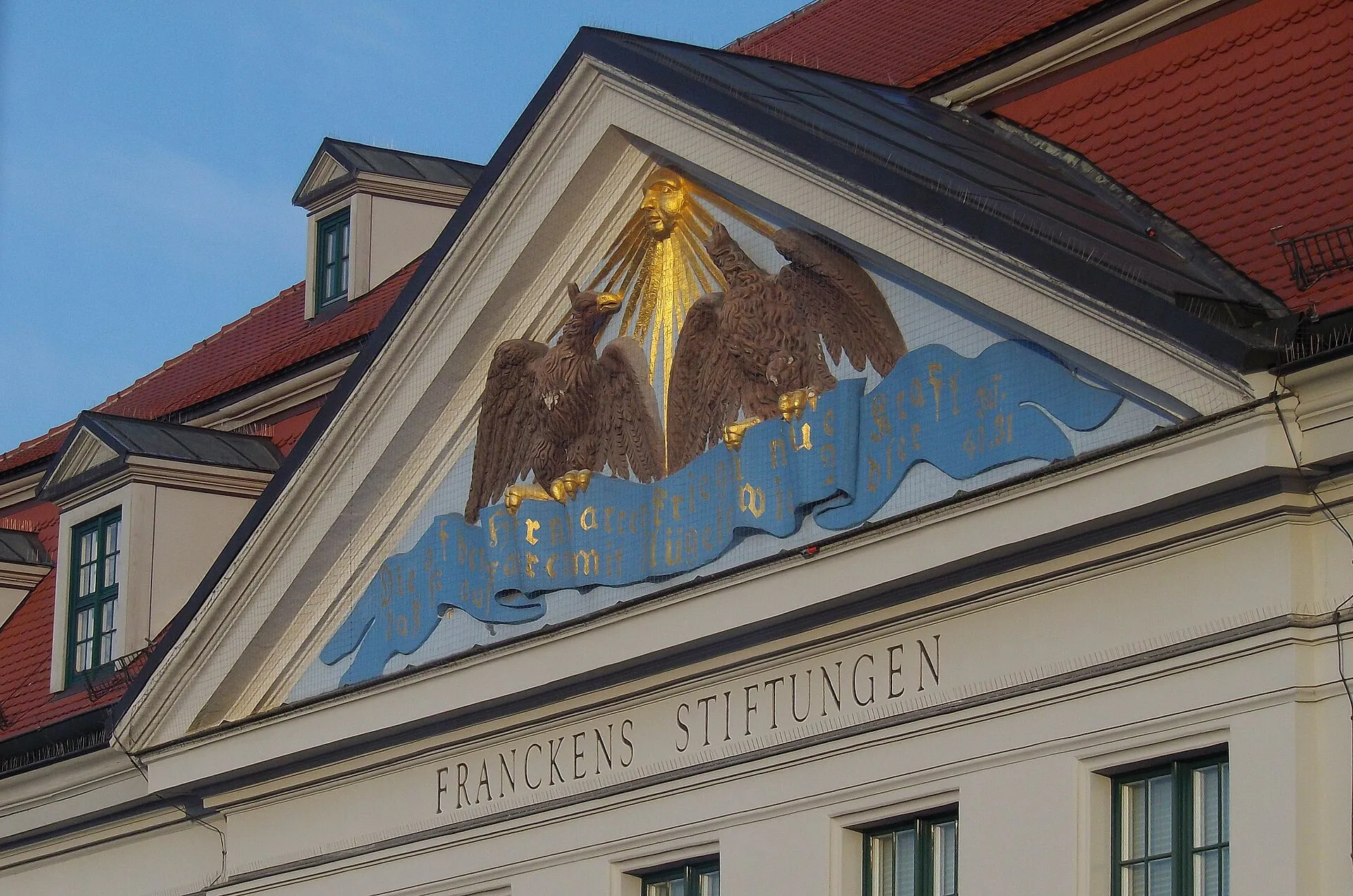
On the pediment of the orphanage's main building, two eagles are carved soaring toward the sun, a ribbon bearing the promise of Isaiah 40:31 — a design Francke chose himself. The institution's motto echoes it: Illo splendente levabor, “When that sun shines, I shall be lifted up.” Between 1713 and 1716, the Langes Haus — some 115 meters long and six stories — went up, Europe's largest timber-framed building, housing nothing but students.
By the time Francke died in 1727, this “school-city” had more than 2,200 enrolled students and 175 teachers, with the whole “school-city” numbering about 3,000 people. Francke founded Germany's first teacher-training seminary; his model helped bring about Prussia's 1717 school attendance decree and later influenced the 1763 compulsory-education statute — the lineage of German compulsory education carries this orphanage's mark.
An Honest Balance
By the common assessment of church history, Pietism never broke from the Lutheran church: it revived a cold institution and shaped both Zinzendorf and the Wesley brothers. But it also drifted toward an extreme of asceticism and rigorous self-denial, at times hardening into harshness and legalism, and by undervaluing doctrine it unintentionally paved the way for the liberal theology that followed. In 1723, under pressure from Pietist theologians, the Prussian king ordered the philosopher Christian Wolff to leave the country within 48 hours — the spark being a 1721 lecture in which Wolff had praised Confucius and the rational morality of the Chinese. Francke's death in 1727 also marked Pietism's high-water mark.
The theology faculty at Halle was once Germany's largest, training roughly six thousand church workers; the first light of the modern missionary movement was fired from this city. The orphanage courtyard still stands, and the eagles on its pediment still face the sun. Three hundred years later, a group of Chinese Christians in this same city are learning to pray — trusting the same God who hears prayer.
People in this line
Sources
- August Hermann Francke (English Wikipedia)
- August Hermann Francke: biography (Francke Foundations official site)
- History of the Francke Foundations (Francke Foundations official site)
- The eagle pediment (Francke Foundations building tour)
- Philipp Spener (English Wikipedia)
- The Wolff affair (Stanford Encyclopedia of Philosophy)